CNC Cutting Machine Guide: Basics, Working Principles, Types, and Applications
A CNC cutting machine is a computer-controlled system that cuts, shapes, or processes materials according to programmed instructions. CNC stands for Computer Numerical Control. The technology uses digital designs and coordinated machine movements to produce accurate shapes with limited manual intervention during operation.
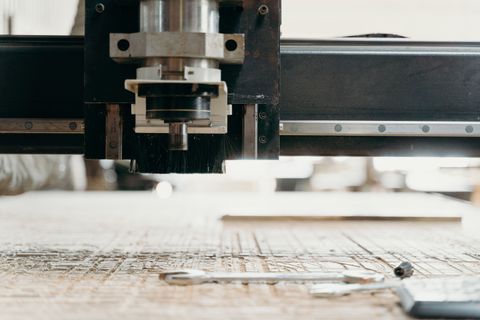
CNC systems are used to process metals, plastics, wood, composites, and other industrial materials. Depending on the equipment, cutting may involve a rotating tool, a laser beam, a plasma arc, a water jet, or a mechanical blade.
A typical CNC cutting process begins with a digital design created using computer-aided design (CAD) software. The design is converted into machine instructions through computer-aided manufacturing (CAM) software or another suitable programming method. The machine then follows those instructions to complete the required cutting operation.
How Does a CNC Cutting Machine Work?
The working principle combines digital instructions, motion control, and a material-processing method. Each stage contributes to the accuracy and consistency of the final component.
The basic process includes:
Design preparation: An engineer creates a two-dimensional or three-dimensional model using CAD software.
Toolpath generation: CAM software determines the cutting path, tool movements, and operating parameters.
Machine setup: The operator secures the material and selects suitable tools, settings, and safety procedures.
Automated cutting: The CNC controller coordinates the machine axes and cutting equipment according to the program.
Quality inspection: The finished component is checked for dimensions, surface quality, and other specifications.
The final result depends on several factors, including material thickness, machine condition, cutting speed, tool selection, programming accuracy, and operator knowledge.
Main Types of CNC Cutting Machines
Different machines use different cutting technologies. The appropriate option depends on the material, component geometry, required precision, and production environment.
| Machine type | Working method | Common applications |
|---|---|---|
| CNC laser cutting machine | Uses a concentrated laser beam | Sheet metal, intricate profiles, precision parts |
| Fiber laser cutting machine | Uses a fiber-based laser source | Steel, stainless steel, aluminum and other compatible metals |
| CNC plasma cutting machine | Uses an electrically conductive plasma arc | Steel plates, structural metal components |
| CNC waterjet cutting machine | Uses a high-pressure water stream, sometimes with abrasive particles | Metals, stone, glass and heat-sensitive materials |
| CNC router | Uses a rotating cutting tool | Wood, plastics, panels and composites |
| CNC milling machine | Removes material with rotating cutting tools | Mechanical components, slots, pockets and complex surfaces |
A CNC milling machine is primarily a material-removal system rather than a dedicated laser or plasma cutter. However, it belongs to the broader CNC manufacturing category and is frequently used alongside cutting equipment.
Why CNC Cutting Technology Matters Today
Importance in Modern Manufacturing
Manufacturers need repeatable dimensions, efficient material use, consistent quality, and predictable production processes. CNC technology helps address these requirements by converting digital designs into controlled machine movements.
Automation can reduce repetitive manual operations and make it easier to reproduce complex shapes. It also supports production planning because programmed cutting paths can be stored, reviewed, and reused when the same component is manufactured again.
CNC technology is particularly relevant to automotive manufacturing, aerospace components, construction equipment, electrical enclosures, furniture production, and general engineering.
Problems Solved by CNC Cutting
Traditional manual cutting can require considerable operator skill and may produce variations between components. CNC systems help manage several common manufacturing challenges:
Dimensional variation: Programmed movements support consistent component geometry.
Complex designs: Computer-generated toolpaths can handle intricate profiles and repeated features.
Material waste: Nesting software can arrange multiple parts on a sheet to improve material utilization.
Production delays: Automated movement reduces some manual steps and supports repeatable workflows.
Quality control: Digital programs and measurement records make it easier to investigate manufacturing differences.
These benefits are not automatic. Poor programming, incorrect machine settings, unsuitable material, and inadequate maintenance can still result in defects.
Who Uses CNC Cutting Machines?
CNC cutting technology affects a wide range of professionals and industries.
Manufacturing engineers use it to develop production methods and select suitable equipment.
Mechanical designers prepare drawings and component geometry.
Fabrication facilities process sheet metal, plates, and structural parts.
Automotive and aerospace manufacturers produce components to defined engineering specifications.
Small workshops use compact CNC routers and milling machines for customized manufacturing.
Quality-control teams inspect finished parts and verify compliance with technical drawings.
CNC machining services and CNC milling services are relevant terms when researching manufacturing processes that combine cutting, drilling, milling, and other precision operations. Their suitability depends on the component design and the capabilities of the equipment involved.
Recent Developments and Manufacturing Trends
Manufacturing technology continues to evolve through automation, digital monitoring, and improved cutting systems. These developments influence how factories plan production, maintain equipment, and monitor component quality.
On 29 October 2025, NITI Aayog unveiled Reimagining Manufacturing: India’s Roadmap to Global Leadership in Advanced Manufacturing. The roadmap highlighted artificial intelligence, machine learning, digital twins, advanced materials, and robotics as important technologies for strengthening manufacturing capabilities. These technologies are relevant to CNC operations because they can support production monitoring, process planning, and equipment optimization. <Cite refs={["turn576474search0"]}/>
Other important trends include:
Advanced fiber laser technology: Modern fiber laser systems support precise processing of compatible metals and complex sheet profiles.
Smart manufacturing: Sensors and connected equipment help operators monitor machine conditions and identify production interruptions.
Digital twins: Virtual representations of machines or production systems can help engineers study processes before making physical changes.
Automated material handling: Robotic loading and unloading can reduce repetitive manual tasks in suitable production environments.
Improved nesting software: Digital tools help arrange component shapes on sheets to manage material utilization.
These developments do not eliminate the need for skilled operators. Proper programming, preventive maintenance, and quality checks remain essential for reliable manufacturing.
Practical Considerations When Selecting Equipment
Selecting a CNC cutting machine requires evaluating the intended application rather than focusing on a single technical specification.
Important considerations include:
Material compatibility: Confirm that the technology is suitable for the material being processed.
Material thickness: Check the machine's documented cutting capacity for each material type.
Dimensional accuracy: Compare the required tolerances with the machine's demonstrated performance.
Production volume: Consider whether the equipment can handle the expected workload consistently.
Operating environment: Assess ventilation, electrical requirements, floor space, and material-handling arrangements.
Software compatibility: Ensure that the design and programming software supports the machine controller.
Maintenance requirements: Review calibration procedures, consumables, cleaning schedules, and component replacement guidance.
For example, a fiber laser cutting machine may be appropriate for detailed metal sheet profiles, while a CNC milling machine is better suited to producing pockets, slots, and three-dimensional features in a component.
Regulations, Safety Standards, and Government Initiatives in India
Workplace Safety and Machinery Compliance
CNC equipment introduces hazards involving moving parts, electricity, hot surfaces, fumes, laser radiation, and flying debris. Industrial facilities must identify these risks and establish appropriate safety controls.
India's Occupational Safety, Health and Working Conditions Code, 2020, came into force on 21 November 2025, according to official government information. It provides a consolidated framework for workplace health, safety, and working conditions. Its application and related requirements depend on the establishment, applicable rules, and relevant provisions. <Cite refs={["turn576474search6","turn576474search2"]}/>
Important safety practices for CNC operations include:
Use suitable machine guards, interlocks, and emergency-stop systems.
Provide training before allowing operators to run equipment independently.
Follow appropriate eye protection requirements for laser systems.
Install suitable ventilation and extraction for smoke, dust, and fumes.
Isolate energy sources before maintenance or internal machine access.
Keep maintenance logs, operating instructions, and risk assessments up to date.
Technical Standards and Government Programs
The Bureau of Indian Standards publishes standards relevant to machinery safety. For example, IS 18165:2023, based on ISO 17916:2016, addresses safety requirements for thermal cutting machines, including specified plasma and oxy-fuel systems. It does not cover every hazard associated with laser equipment, so the applicable standards must be checked for the particular machine. <Cite refs={["turn576474search26"]}/>
India's manufacturing policy initiatives also encourage technological development and stronger industrial capabilities. NITI Aayog's October 2025 advanced manufacturing roadmap emphasizes the role of emerging technologies in industrial competitiveness. However, the availability of a government initiative does not automatically mean that every CNC machine or facility qualifies for a particular benefit. <Cite refs={["turn576474search0","turn576474search4"]}/>
Manufacturers should verify current central and state requirements, relevant Indian Standards, electrical safety provisions, and any applicable conformity or registration requirements before installing or importing machinery.
Tools and Resources for CNC Cutting
Useful Software and Technical Resources
Digital tools help users prepare designs, plan cutting paths, estimate material requirements, and evaluate manufacturing quality.
| Tool or resource | Main purpose |
|---|---|
| <Entity value="Autodesk Fusion" category="software"/> | CAD design, CAM programming, and toolpath preparation |
| <Entity value="FreeCAD" category="software"/> | Open-source 3D modeling and engineering design |
| <Entity value="LightBurn" category="software"/> | Laser design and machine control for supported systems |
| <Entity value="Bureau of Indian Standards" category="organization"/> | Indian technical standards and safety guidance |
| <Entity value="NITI Aayog" category="organization"/> | Manufacturing policy reports and technology roadmaps |
Useful online resources include the Autodesk Fusion website, FreeCAD documentation, LightBurn documentation, and BIS.
Basic Calculations and Planning
Several calculations help engineers prepare a CNC cutting process.
Cutting speed: The speed at which the cutting point moves relative to the material.
Feed rate: The distance the cutting tool travels per unit of time.
Material utilization: The proportion of the original sheet or stock that becomes usable components.
Cycle time: The time required to complete a defined manufacturing operation.
Material utilization can be expressed as:
[
\text{Utilization (%)}=
\frac{\text{Usable material area}}{\text{Total sheet area}}\times100
]
For example, if usable components occupy 7,200 square millimeters of a 10,000-square-millimeter sheet, utilization is 72%. Actual planning should also account for kerf width, part spacing, clamping requirements, and unusable edges.
Frequently Asked Questions
What is the main purpose of a CNC cutting machine?
Its main purpose is to cut or shape materials using computer-controlled instructions. It helps produce repeatable components, follow complex cutting paths, and maintain consistent dimensions when the machine and process are correctly configured.
What is the difference between CNC laser cutting and CNC milling?
Laser cutting uses a concentrated beam of light to process material, while CNC milling removes material using rotating cutting tools. Laser cutting is commonly used for sheet profiles, whereas milling is suitable for slots, pockets, holes, and three-dimensional component features.
Which materials can a CNC metal cutting machine process?
Depending on its cutting technology and specifications, a CNC metal cutting machine may process carbon steel, stainless steel, aluminum, and other compatible metals. Material thickness, reflectivity, thermal properties, and machine capacity influence the appropriate method.
Is a fiber laser cutting machine suitable for every metal?
No. Fiber lasers can process many industrial metals, but suitability depends on the metal's properties, thickness, laser power, equipment configuration, and required finish. The manufacturer's technical documentation should guide material selection.
What safety precautions are necessary when operating CNC equipment?
Operators should follow the machine's instructions, use required protective equipment, maintain guarding and interlocks, control fumes and dust, and apply energy-isolation procedures during maintenance. Laser systems also require appropriate controls against direct and reflected laser radiation.
Conclusion
CNC cutting machines are important tools in modern manufacturing because they combine digital design, programmed motion, and specialized cutting technologies. Laser cutting, plasma cutting, waterjet cutting, routing, and milling each serve different purposes.
Understanding their working principles, material compatibility, accuracy, and limitations helps engineers and operators select appropriate equipment. Recent developments in robotics, digital monitoring, and advanced manufacturing are expanding CNC capabilities, while workplace safety and technical compliance remain essential.
For reliable results, organizations should combine suitable technology with trained operators, effective maintenance, accurate programming, and consistent quality inspection.

Related Post...
CNC Cutting Machine Guide: Basics, Working Principles, Types, and Applications
Updated: October 22, 2026
Read More