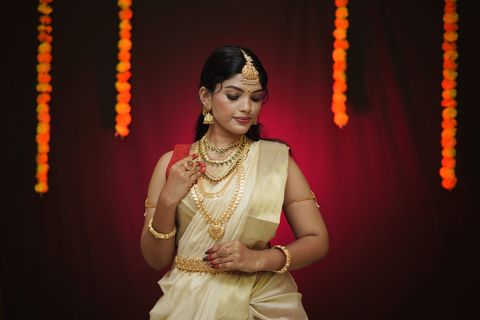
Onam Traditional Gold Designs Guide: Explore Kerala Jewellery Styles, Designs, and Cultural Significance
Onam is one of Kerala's most important cultural festivals, celebrated with enthusiasm across the state and by Malayali communities worldwide. The festival is associated with the legendary King Mahabali, seasonal celebrations, traditional meals, cultural performances, floral decorations, and family gatherings. Jewellery forms an important part of festive dressing, particularly when people wear traditional Kerala clothing such as Kasavu sarees, mundu, and other regional garments.
Traditional gold jewellery in Kerala reflects a combination of cultural heritage, craftsmanship, regional identity, and personal expression. Its designs range from delicate chains and small pendants to elaborate necklaces, layered ornaments, and decorative earrings.
Onam gold jewellery designs often draw inspiration from traditional Kerala ornaments, temple motifs, floral patterns, and classical jewellery arrangements. Some people prefer heritage-inspired pieces, while others combine traditional designs with contemporary styles.
Cultural Importance of Gold Jewellery in Kerala
Gold has a long-standing cultural presence in Kerala, particularly in family celebrations, weddings, religious occasions, and festivals. Jewellery may represent family traditions, personal milestones, cultural identity, and artistic craftsmanship.
Traditional Kerala jewellery is often recognized through its distinctive shapes, decorative motifs, and layered arrangements. Designs may feature flowers, leaves, coins, goddess-inspired imagery, geometric patterns, and traditional pendants.
The cultural meaning of jewellery can differ between families and communities. Some ornaments are associated with specific ceremonies, while others are worn more broadly during festive occasions.
Why Onam Jewellery Is Special
Onam celebrations bring together traditional clothing, cultural activities, and family customs. Jewellery contributes to the overall festive appearance by complementing regional attire and highlighting traditional craftsmanship.
Common reasons people choose traditional jewellery during Onam include:
Celebrating Kerala's cultural heritage.
Complementing traditional Kasavu sarees and festive clothing.
Wearing ornaments associated with family traditions.
Appreciating traditional gold craftsmanship.
Creating a coordinated appearance for family photographs and celebrations.
Preserving meaningful jewellery pieces across generations.
Traditional gold jewellery is not limited to elaborate ornaments. Simple chains, small earrings, and understated pendants can also complement Onam clothing.
Popular Traditional Kerala Gold Jewellery Designs
Kerala has a rich jewellery tradition featuring distinctive necklaces, earrings, bangles, waist ornaments, and decorative accessories. Many traditional designs remain recognizable because of their historical associations and characteristic craftsmanship.
Kasu Mala: Traditional Coin Necklace
<AsyncImageGroup query={["Kerala traditional gold Kasu Mala coin necklace","traditional Kerala Lakshmi Kasu Mala gold jewellery"]} aspectRatio="4:5"/>
Kasu Mala is a traditional necklace featuring coin-shaped gold elements arranged along a chain. The word kasu is associated with coins, while mala refers to a necklace.
The design may contain closely arranged circular elements, decorative coin motifs, or traditional patterns inspired by older coin jewellery.
Kasu Mala is commonly associated with Kerala bridal jewellery and traditional festive styling. Its appearance can range from relatively delicate arrangements to longer, more elaborate necklaces.
Palakka Mala: Leaf-Inspired Necklace
<AsyncImageGroup query={["Kerala traditional Palakka Mala green leaf gold necklace","Palakka Mala Kerala gold jewellery closeup"]} aspectRatio="4:5"/>
Palakka Mala is a distinctive Kerala necklace associated with leaf-shaped decorative elements. Many traditional versions feature green enamel or green-colored details, although variations exist.
Its repeated leaf motifs create a recognizable pattern that distinguishes it from coin necklaces and plain gold chains.
Palakka Mala is often worn with traditional Kerala attire because its regional design identity complements festive clothing.
Manga Mala: Mango Motif Necklace
<AsyncImageGroup query={["Kerala traditional Manga Mala mango motif gold necklace","Manga Mala Kerala traditional jewellery gold"]} aspectRatio="4:5"/>
Manga Mala features mango-shaped decorative elements inspired by the mango motif, which appears in several Indian jewellery traditions.
The design may include repeated mango forms, small gemstones, or decorative gold detailing. Its structure can vary according to the necklace's length and arrangement.
Manga Mala is frequently associated with traditional Kerala bridal jewellery and festive occasions.
Nagapadam Necklace: Snake-Hood Inspired Design
<AsyncImageGroup query={["Kerala traditional Nagapadam gold necklace","Nagapadam Kerala bridal jewellery gold"]} aspectRatio="4:5"/>
Nagapadam is a traditional Kerala necklace design known for its distinctive snake-hood-inspired decorative elements. The name is associated with the visual form of a serpent's hood.
Some designs feature gemstone accents or symmetrical decorative elements. The central motifs create a visually distinctive arrangement that differs from ordinary chain necklaces.
Nagapadam is often included in discussions of Kerala heritage jewellery and traditional bridal ornaments.
Kerala Temple Jewellery
<AsyncImageGroup query={["Kerala traditional temple jewellery gold necklace Lakshmi","Kerala temple jewellery traditional gold pendant"]} aspectRatio="4:5"/>
Temple jewellery is associated with decorative motifs inspired by religious imagery, including goddess figures, floral patterns, and traditional ornamental designs.
Kerala temple-inspired jewellery may feature Lakshmi motifs, intricate relief work, and decorative gold surfaces. Such designs are often associated with ceremonial and classical styling.
Temple-inspired ornaments are also worn during cultural performances and traditional celebrations, depending on the design and occasion.
Kerala Gold Necklace Designs for Onam
Necklaces are among the most recognizable elements of traditional Kerala jewellery. Their design, length, and decorative arrangement can influence the overall appearance of festive clothing.
Common Kerala Necklace Styles
| Necklace style | Design characteristics | Traditional appearance |
|---|---|---|
| Kasu Mala | Coin-shaped decorative elements | Heritage-inspired |
| Palakka Mala | Leaf motifs, often green accents | Distinctive and regional |
| Manga Mala | Mango-shaped repeated motifs | Decorative and traditional |
| Nagapadam | Snake-hood-inspired elements | Recognizable Kerala design |
| Temple necklace | Religious and floral motifs | Ornamental |
| Mullamottu Mala | Jasmine-bud-inspired elements | Delicate and patterned |
| Simple gold chain | Plain or lightly decorated chain | Understated |
The names and construction of traditional ornaments can vary across families, communities, and jewellery-making traditions. Contemporary versions may combine traditional motifs with modern settings, lighter structures, or different decorative finishes.
Layered Kerala Necklace Styling
Layered necklaces are often associated with traditional bridal jewellery, but simpler layered arrangements can also be suitable for festive clothing.
A coordinated arrangement may include:
A short necklace near the neckline.
A medium-length traditional necklace.
A longer decorative chain.
A pendant or central ornamental piece.
Layering should consider necklace length, visual balance, and comfort. Several heavy necklaces may be uncomfortable for extended celebrations, while lighter arrangements can create a traditional appearance with less weight.
Traditional Kerala Earrings and Other Gold Ornaments
Kerala jewellery includes more than necklaces. Earrings, bangles, waist ornaments, and decorative accessories also contribute to traditional festive styling.
Jhimikki: Traditional Hanging Earrings
<AsyncImageGroup query={["Kerala traditional gold Jhimikki earrings","Kerala traditional gold Jhumka Jhimikki earrings"]} aspectRatio="4:5"/>
Jhimikki earrings are associated with hanging or bell-shaped decorative forms. Traditional designs may feature intricate gold detailing, small beads, gemstone accents, or ornamental patterns.
Their shape creates movement and visual emphasis around the face. Different versions vary in size, weight, and decorative complexity.
Traditional Gold Bangles
<AsyncImageGroup query={["Kerala traditional gold bangles designs","Kerala traditional antique gold bangles"]} aspectRatio="4:5"/>
Gold bangles are commonly included in traditional festive and ceremonial jewellery arrangements. Designs may be plain, textured, engraved, or decorated with repeated floral patterns.
Some Kerala-inspired bangles feature antique-style finishes or detailed ornamental surfaces. Others use simpler forms that complement contemporary clothing.
Other Traditional Kerala Ornaments
Muthu Mala: A necklace associated with pearl-like decorative elements.
Mullamottu Mala: A necklace inspired by jasmine buds.
Traditional waist ornaments: Decorative belts and waist jewellery used in certain ceremonial or classical arrangements.
Hair ornaments: Decorative accessories used with traditional hairstyles.
Nettichutti: A forehead ornament associated with traditional bridal and ceremonial jewellery.
Traditional rings: Decorative gold rings featuring floral, geometric, or gemstone patterns.
These ornaments may be worn differently depending on the occasion, clothing, and personal preferences.
Antique Gold Jewellery Kerala: Heritage and Craftsmanship
Antique gold jewellery Kerala refers broadly to jewellery designs inspired by historical ornaments, traditional motifs, and heritage-style finishing. The term may describe an aesthetic rather than the actual age of a piece.
Antique-inspired jewellery often features darker surface finishes, intricate decorative patterns, floral motifs, and traditional sculptural elements.
Characteristics of Antique-Inspired Jewellery
Traditional motifs such as flowers, leaves, and religious imagery.
Textured surfaces and detailed decorative work.
Vintage-inspired proportions and ornamental arrangements.
Darker or oxidized-looking finishes.
Designs inspired by older regional jewellery traditions.
An antique-style pendant or necklace can complement traditional Kerala clothing, particularly when its decorative details match the overall outfit.
It is important to distinguish between genuine antique jewellery and newly manufactured jewellery with an antique finish. The visual appearance alone does not establish the age of an ornament.
Premium Gold Jewellery Designs for Onam
Premium gold jewellery designs may include elaborate necklaces, detailed pendants, decorative earrings, and coordinated traditional ornaments.
The term premium can refer to craftsmanship, design complexity, material characteristics, or the overall presentation of jewellery. It does not automatically indicate a particular gold purity or gemstone quality.
Features Commonly Found in Elaborate Designs
Detailed floral or temple-inspired motifs.
Intricate engraving and decorative surfaces.
Carefully arranged gemstone accents.
Symmetrical patterns and ornamental shapes.
Coordinated necklace and earring combinations.
Traditional motifs combined with contemporary styling.
Premium designs may be elaborate, but simplicity can also create an elegant festive appearance. Jewellery selection depends on personal preferences, clothing, comfort, and the occasion.
Onam Jewellery Styling with Kasavu Sarees
<AsyncImageGroup query={["Kerala Kasavu saree traditional gold jewellery Onam outfit","Kerala woman traditional Kasavu saree gold necklace festive style"]} aspectRatio="4:5"/>
Kasavu sarees are associated with Kerala's traditional clothing and are frequently worn during Onam celebrations. Their characteristic light-colored fabric and gold-toned border create a distinctive regional appearance.
Traditional gold jewellery complements Kasavu clothing through its warm metallic tones and heritage-inspired designs.
Jewellery Styling Ideas
Traditional styling: A Kasu Mala, Palakka Mala, or traditional pendant can complement a classic Kasavu saree.
Minimalist styling: A simple gold chain, small earrings, and understated bangles create a lighter arrangement.
Layered styling: Two or three necklaces with different lengths can create a traditional festive appearance when balanced carefully.
Antique styling: Antique-inspired necklaces and earrings may complement traditional clothing with decorative borders or textured fabrics.
Contemporary styling: Modern gold pendants and geometric earrings can provide a simpler interpretation of festive jewellery.
The best arrangement depends on the saree's design, the wearer’s comfort, and the overall visual balance. Jewellery does not need to be elaborate to complement traditional clothing.
Recent Updates and Contemporary Jewellery Trends
During 2025 and 2026, jewellery design discussions have continued to include lightweight traditional ornaments, personalized designs, heritage-inspired patterns, and contemporary interpretations of regional jewellery.
These developments reflect broad design directions rather than a single universal trend.
Important Design Developments
Lightweight traditional jewellery: Designs inspired by heritage ornaments with reduced weight and simplified construction.
Modern temple motifs: Traditional religious and floral patterns incorporated into contemporary jewellery.
Personalized ornaments: Initials, meaningful dates, and individual design details.
Traditional-modern combinations: Kerala-inspired necklaces paired with contemporary earrings or simple chains.
Heritage aesthetics: Antique-style finishes and motifs inspired by historical jewellery.
Versatile festive jewellery: Pieces intended to complement different traditional and contemporary outfits.
In 2025, discussions around responsible sourcing and jewellery transparency continued to influence the broader precious-metal and gemstone industry. These subjects include material identification, supply-chain documentation, and consumer awareness.
For Onam jewellery, however, cultural continuity remains important. Traditional motifs continue to provide a connection to Kerala's artistic heritage, while modern variations allow individuals to interpret those designs according to personal preferences.
Gold Jewellery Hallmarking and Consumer Protection in India
Gold jewellery in India is influenced by hallmarking requirements, precious-metal standards, and consumer protection rules. These regulations are relevant when understanding the declared purity and material composition of gold ornaments.
BIS Hallmarking
The Bureau of Indian Standards (BIS) operates India's gold hallmarking framework. Mandatory hallmarking applies in designated districts, subject to applicable requirements and exemptions.
A hallmarked gold jewellery item generally carries three important marks:
BIS Standard Mark: Identifies the official hallmark.
Purity mark: Indicates the declared gold purity in karats and fineness.
Hallmark Unique Identification (HUID): A unique six-character alphanumeric identification number.
Consumers can use the BIS CARE application and its Verify HUID feature to check recorded details associated with hallmarked gold jewellery.
Hallmarking Update in 2026
On 2 March 2026, the sixth phase of India's mandatory gold hallmarking expansion came into force. The government announced the inclusion of seven additional districts on 13 March 2026, bringing the reported total to 380 districts covered under the framework.
The exact applicability of hallmarking requirements depends on the relevant order, location, and exemptions.
Consumer Protection Act, 2019
India's Consumer Protection Act, 2019, provides a framework for consumer rights and addresses unfair trade practices and misleading advertisements.
Jewellery descriptions should accurately represent the stated purity, gemstone identity, metal composition, and other relevant characteristics.
Readers should distinguish between gold hallmarking, gemstone grading reports, and general product descriptions because each serves a different purpose.
Essential Tips for Choosing and Maintaining Onam Gold Jewellery
Traditional gold jewellery can remain meaningful across different celebrations when it is selected and maintained carefully.
Practical Jewellery Selection Tips
Consider the design's cultural background and personal significance.
Match necklace proportions with the clothing and intended occasion.
Review gold purity and hallmark information where applicable.
Consider weight and comfort, especially for extended celebrations.
Check chain strength, clasps, and decorative settings.
Understand whether an antique-style piece is genuinely antique or newly manufactured.
Keep documentation describing gold purity and gemstone characteristics.
Choose designs that reflect personal preferences rather than relying only on trends.
Jewellery Care and Storage
Traditional ornaments may contain delicate decorative elements, gemstones, enamel, or intricate settings.
For appropriate maintenance:
Store necklaces separately to prevent tangling.
Avoid unnecessary exposure to harsh chemicals.
Follow material-specific cleaning instructions.
Remove delicate jewellery before activities involving impact.
Inspect clasps and settings periodically.
Keep jewellery in a dry, protected storage environment.
Specialized cleaning methods may not be suitable for every gemstone or ornament. When the materials are uncertain, professional guidance can help prevent damage.
Frequently Asked Questions
1. What is traditional Kerala gold jewellery?
Traditional Kerala gold jewellery includes regional ornaments such as Kasu Mala, Palakka Mala, Manga Mala, Nagapadam, and temple-inspired designs. These ornaments reflect regional craftsmanship, cultural traditions, and distinctive decorative motifs.
2. Which Kerala gold necklace designs are commonly associated with Onam?
Kasu Mala, Palakka Mala, Manga Mala, Nagapadam, and Mullamottu Mala are commonly associated with traditional Kerala jewellery. Their suitability depends on personal style, clothing, and the occasion.
3. What is the cultural significance of Onam gold jewellery?
Gold jewellery can represent cultural identity, family traditions, personal milestones, and festive expression. During Onam, traditional ornaments often complement regional clothing and contribute to the celebration's cultural atmosphere.
4. What is the difference between antique gold jewellery and antique-style jewellery?
Genuine antique jewellery is an older piece with historical age and provenance. Antique-style jewellery is newly manufactured but uses designs, finishes, or motifs inspired by historical ornaments.
5. How can gold jewellery purity be checked in India?
Look for the BIS Standard Mark, purity mark, and HUID on covered hallmarked gold jewellery. The BIS CARE application's Verify HUID feature can help check the recorded details associated with the item.
Conclusion
Onam traditional gold jewellery reflects Kerala's cultural heritage, regional craftsmanship, and distinctive festive styling. Designs such as Kasu Mala, Palakka Mala, Manga Mala, Nagapadam, temple jewellery, and traditional Jhimikki earrings continue to represent recognizable elements of Kerala's jewellery traditions.
Understanding these ornaments helps readers appreciate their decorative features, cultural associations, and differences in design. Traditional gold jewellery can also be interpreted through contemporary styling, lightweight arrangements, and personalized details.
Whether someone prefers antique-inspired necklaces, premium gold ornaments, or simple traditional pendants, the significance of Onam jewellery lies in its connection with culture, personal expression, and celebration.
Knowledge of gold purity, hallmarking, jewellery care, and traditional design characteristics provides a useful foundation for understanding Kerala jewellery and its role in Onam celebrations.

Related Post...
Sun-Kissed Gold Designs Guide: Explore Radiant Styles, Trends, and Essential Tips
Updated: November 03, 2026
Read More
Warm Rose Gold Sets Guide: Explore Elegant Designs, Styles, and Essential Tips
Updated: November 03, 2026
Read More
Eid Elegant Gold Earrings Guide: Explore Festive Designs, Styles, and Essential Tips
Updated: November 04, 2026
Read More