Laser Cutting Machine Overview: Learn Features, Types, Uses, and Important Facts
Laser cutting machines are advanced manufacturing systems that use concentrated laser energy to cut, engrave, or shape different materials. These machines are widely used in industries that require accurate cutting, consistent dimensions, and detailed designs. They can process materials such as stainless steel, mild steel, aluminium, acrylic, wood, plastics, and other compatible materials, depending on the machine's technology and configuration.
Laser cutting technology has become an important part of modern manufacturing because it supports automated production and complex design requirements. It is commonly used in automotive manufacturing, construction, electronics, metal fabrication, furniture production, signage, and industrial equipment manufacturing.
Unlike conventional cutting methods that rely on physical blades or mechanical contact, laser cutting uses a focused beam of light to heat and separate material. The process can involve melting, burning, vaporising, or removing material with the assistance of a gas.
Modern systems frequently combine laser technology with computer numerical control (CNC), allowing operators to control cutting paths through digital design files. This combination helps manufacturers produce consistent shapes and repeatable results.
Understanding the different types, features, uses, and technical specifications of laser cutting machines can help businesses, engineers, students, and manufacturing professionals learn how this technology fits into modern production environments.
Importance of Laser Cutting Technology
Laser cutting technology has transformed several manufacturing processes by introducing accurate, automated, and flexible material processing methods.
Precision and accuracy: A focused laser beam can produce detailed shapes and complex patterns. This makes the technology useful for components that require accurate dimensions and carefully controlled edges.
Production consistency: CNC-controlled systems follow programmed cutting paths. This helps maintain consistency when producing multiple components with similar specifications.
Material flexibility: Depending on the laser source and machine configuration, laser cutting systems can process several types of metals and non-metallic materials.
Reduced mechanical contact: Since the cutting process does not generally require a physical blade to contact the material, certain forms of mechanical wear associated with conventional cutting tools can be reduced.
Design flexibility: Digital design files can be converted into cutting instructions, allowing manufacturers to produce different shapes and patterns without creating a separate physical cutting tool for every design.
Automation: Modern industrial laser cutting machines can be integrated with material-handling systems, production software, and automated manufacturing lines.
What Is a Laser Cutting Machine?
A laser cutting machine is equipment that uses a concentrated beam of light to remove or separate material along a programmed path. The laser source generates energy, which is directed through an optical system and focused onto a specific point on the material.
When the focused beam reaches the material, it creates intense heat. Depending on the material and process, the laser may melt, vaporise, or burn through the selected area. Assist gases such as oxygen, nitrogen, or compressed air may be used to remove molten material and influence cutting quality.
A typical laser cutting machine includes several major components:
Laser source: Generates the laser beam used for cutting.
Optical system: Directs and focuses the laser energy.
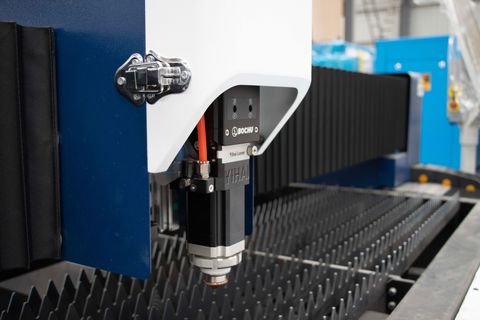
Cutting head: Holds optical components and delivers the beam towards the material.
CNC controller: Controls the movement of the cutting head and cutting path.
Machine bed: Supports the material during processing.
Motion system: Moves the cutting head or workpiece according to programmed instructions.
Cooling system: Helps maintain appropriate operating temperatures.
Assist gas system: Supplies gas to support the cutting process.
Safety enclosure: Helps protect operators from laser radiation, sparks, and other process hazards.
These components work together to create a controlled cutting process.
Types of Laser Cutting Machines
Laser cutting machines are available in different configurations. The main differences involve the laser source, wavelength, power, material compatibility, and intended application.
1. Fiber Laser Cutting Machine
A fiber laser cutting machine uses optical fiber as the medium for generating and delivering laser energy. These systems are widely used in metal fabrication because they can process many industrial metals with high precision.
Fiber laser technology is particularly common in applications involving stainless steel, carbon steel, aluminium, brass, and copper, subject to machine specifications and material thickness.
Important characteristics include:
High energy efficiency in many industrial applications.
Strong performance when processing compatible metal materials.
Compact laser source designs.
Accurate cutting capabilities.
Compatibility with automated CNC systems.
Relatively low maintenance requirements in certain configurations.
Fiber laser cutting machines are commonly used in automotive manufacturing, sheet metal fabrication, electrical equipment production, and industrial component manufacturing.
2. CO2 Laser Cutting Machine
A CO2 laser cutting machine generates laser energy using a gas mixture that primarily includes carbon dioxide. It operates at a different wavelength from fiber laser systems and is widely used for cutting and engraving non-metallic materials.
Depending on its power and configuration, a CO2 laser machine can process materials such as:
Acrylic.
Wood.
Paper and cardboard.
Leather.
Fabric.
Selected plastics.
Certain coated and non-ferrous materials.
CO2 systems are commonly used in signage, packaging, decorative manufacturing, textile processing, and product customisation.
However, material compatibility must always be checked. Some plastics release hazardous fumes when processed with lasers and should never be cut without confirming their chemical composition and safety requirements.
3. CNC Laser Cutting Machine
A CNC laser cutting machine combines laser technology with computer numerical control. The system uses programmed instructions to control the cutting head and follow specific design paths.
Operators generally prepare designs using computer-aided design (CAD) software and convert them into machine-readable instructions.
Major features include:
Digital cutting-path control.
Repeatable production operations.
Automated movement.
Accurate shape processing.
Compatibility with different design formats.
Integration with manufacturing workflows.
CNC laser cutting machines are used in metal fabrication, industrial manufacturing, electronic components, automotive parts, and customised product production.
4. Industrial Laser Cutting Machine
Industrial laser cutting machines are designed for demanding production environments. They are commonly used where manufacturers need to process large quantities of material or work with thicker sheets and complex components.
These systems may include high-power laser sources, large working areas, automatic loading arrangements, advanced cooling systems, and specialised cutting heads.
Their applications include:
Automotive body components.
Industrial machinery parts.
Construction materials.
Metal enclosures.
Heavy equipment components.
Electrical cabinets.
Precision sheet metal products.
The machine configuration depends on material type, production volume, thickness requirements, and factory layout.
5. 3D Laser Cutting Machine
A 3D laser cutting machine is designed to process three-dimensional components rather than only flat sheets. It can direct the laser beam along multiple axes to cut complex shapes and curved surfaces.
These systems are useful for manufacturing components with irregular geometries and specialised design requirements.
Common applications include automotive frames, metal tubes, formed components, structural parts, and complex industrial assemblies.
6. Tube and Pipe Laser Cutting Machine
Tube and pipe laser cutting machines are designed to process cylindrical, square, rectangular, and other hollow metal profiles.
They can perform operations such as cutting, slotting, drilling, and shaping according to programmed designs.
These machines are used in:
Furniture frames.
Automotive structures.
Metal railings.
Industrial piping components.
Construction frameworks.
Fitness equipment.
Agricultural machinery.
Their specialised material-handling systems help position and rotate tubes during processing.
Important Features of Laser Cutting Machines
When understanding a laser cutter machine, it is important to examine the technical features that influence its operation, performance, and material compatibility.
1. Laser Power
Laser power is generally measured in watts or kilowatts. It influences the machine's ability to process different materials and thicknesses.
Higher laser power can support faster cutting or greater material thickness under suitable conditions. However, power alone does not determine cutting quality. Other factors include material composition, focal position, cutting speed, assist gas, and machine configuration.
2. Cutting Accuracy
Cutting accuracy refers to how closely the finished component matches the intended dimensions and design.
Factors that influence accuracy include:
Machine structure.
Motion-system quality.
Optical alignment.
Material stability.
CNC control.
Cutting parameters.
Thermal distortion.
Accurate calibration and regular maintenance help maintain consistent results.
3. Cutting Speed
Cutting speed describes how quickly a machine moves along the cutting path while processing material.
It depends on laser power, material type, thickness, assist gas, and the required edge quality. Excessive speed can lead to incomplete cutting, while an unsuitable slow setting may create unnecessary heat effects.
4. Working Area
The working area determines the maximum material dimensions that can be accommodated by the machine.
Smaller systems are commonly used for compact components and engraving applications. Larger industrial systems can process bigger metal sheets and support high-volume production environments.
5. CNC Control System
The CNC control system manages machine movement and follows the programmed cutting design.
Modern systems may include features such as:
Automatic cutting-path generation.
Material positioning.
Speed and power adjustments.
Machine monitoring.
Error detection.
Production-data management.
6. Cooling System
Laser sources and other machine components generate heat during operation. Cooling systems help maintain suitable temperatures and support stable machine performance.
Depending on the machine design, cooling may involve water-based chillers, air cooling, or specialised thermal-management systems.
7. Assist Gas Technology
Assist gases help remove molten or vaporised material from the cutting area. They can also influence the appearance and quality of the finished edge.
Common gases include:
Oxygen: Often used for cutting carbon steel through an oxidation-assisted process.
Nitrogen: Commonly used where oxidation needs to be reduced, particularly in stainless steel applications.
Compressed air: Used in selected applications where machine and material specifications permit it.
The correct gas depends on material composition, thickness, cutting requirements, and desired edge characteristics.
Uses of Laser Cutting Machines Across Industries
Laser cutting technology supports a wide range of manufacturing and design activities.
Automotive Industry
Automotive manufacturers use laser cutting systems to process metal sheets, structural components, brackets, panels, and other vehicle parts.
The technology supports accurate shapes and can be integrated into automated production environments.
Construction and Infrastructure
The construction industry uses laser-cut metal components for structural frameworks, brackets, panels, support structures, and architectural elements.
It is also used to produce decorative metal patterns and customised building components.
Electronics Manufacturing
Electronic equipment frequently requires small and accurately shaped metal parts. Laser cutting can process selected enclosures, panels, brackets, and component housings.
Furniture Manufacturing
Metal furniture frames, decorative panels, supports, and customised designs can be produced using laser cutting systems.
CO2 laser machines may also be used for compatible wooden and acrylic decorative components.
Signage and Advertising
Laser cutting is used to produce lettering, logos, decorative patterns, acrylic displays, and other signage components.
Medical Equipment Manufacturing
Selected medical equipment components and precision metal parts can be manufactured using laser cutting. Material compatibility, cleanliness, and applicable industry standards are particularly important in this field.
Aerospace Manufacturing
Aerospace production involves components that require carefully controlled dimensions and material specifications. Laser cutting may be used for selected sheet metal parts and structural components, subject to strict engineering and quality requirements.
Fiber Laser Cutter vs CO2 Laser Cutting Machine
Fiber and CO2 systems are two important laser technologies, but their applications are not identical.
Feature | Fiber Laser Cutter | CO2 Laser Cutting Machine |
|---|---|---|
Laser source | Optical fiber | Carbon dioxide gas mixture |
Common applications | Metal processing | Non-metal processing and selected materials |
Typical materials | Steel, aluminium, brass, copper | Acrylic, wood, fabric, paper |
Wavelength | Approximately 1.06–1.08 micrometres | Approximately 10.6 micrometres |
Industrial use | Metal fabrication | Signage, packaging, decorative processing |
Maintenance | Often lower source maintenance | May require additional optical-path maintenance |
Machine configuration | Metal-focused systems are common | Available in several sizes and configurations |
The appropriate technology depends on the material being processed, required thickness, production volume, and desired finish.
Benefits of Using Laser Metal Cutting Machines
Laser metal cutting machines provide several advantages in modern manufacturing.
High precision: A focused laser beam can produce detailed shapes and controlled cutting paths.
Flexible production: Digital designs can be modified to accommodate different component shapes without creating a new physical cutting die for every design.
Reduced tool contact: The laser process does not generally depend on a physical cutting blade contacting the material.
Automation support: CNC systems can automate cutting movements and help maintain production consistency.
Complex design capability: Laser systems can process detailed patterns, small openings, and complex geometries when suitable machine parameters are used.
Material utilisation: Proper nesting software can arrange components on sheets to reduce unused material.
Repeatability: Programmed cutting instructions can support consistent production of multiple components.
However, results depend on equipment specifications, operator knowledge, material characteristics, and process settings.
Factors to Consider When Evaluating a Laser Equipment Supplier or Manufacturer
Understanding machine specifications is important when comparing equipment manufacturers and suppliers. A suitable machine should match the intended production requirements.
Machine specifications: Review laser power, working dimensions, cutting capacity, positioning accuracy, and supported material types.
Technology selection: Confirm whether a fiber, CO2, or another laser configuration is suitable for the intended application.
Technical documentation: Examine operating instructions, maintenance schedules, safety information, and equipment specifications.
Component quality: Understand the specifications of the laser source, cutting head, motion system, controller, and cooling equipment.
Safety features: Check enclosure design, interlocks, emergency-stop arrangements, extraction systems, and laser-protection provisions.
Training and technical knowledge: Operators need appropriate training to understand machine operation, material compatibility, and safety procedures.
Production compatibility: Consider how the equipment will fit into existing manufacturing workflows, material-handling systems, and factory operations.
Compliance documentation: Review applicable product standards, electrical safety information, and other relevant regulatory documentation.
A laser cutting machine manufacturer should provide clear technical information about the machine's capabilities and operating limitations.
Safety Measures for Operating Laser Cutting Machines
Laser cutting equipment involves high-energy radiation, heat, sparks, electrical systems, and potentially hazardous fumes. Proper safety procedures are essential.
Laser protection: Use equipment with suitable protective enclosures and interlocking systems.
Operator training: Only trained personnel should operate or maintain industrial laser equipment.
Protective equipment: Use appropriate eye protection and other personal protective equipment as specified by the machine manufacturer and workplace safety assessment.
Fume extraction: Install suitable extraction and filtration systems to manage smoke, dust, and harmful emissions.
Fire prevention: Keep combustible materials away from the cutting area and maintain appropriate fire-safety arrangements.
Electrical safety: Follow electrical isolation procedures before maintenance.
Material verification: Confirm the chemical composition of materials before processing them.
Machine inspection: Regularly inspect cooling systems, optical components, gas connections, and safety devices.
Materials such as PVC should not be laser-cut because they can release highly hazardous corrosive gases. Unknown plastics should also be avoided until their composition and processing safety have been verified.
Recent Developments and Trends in Laser Cutting Technology (2025–2026)
Laser cutting technology continues to develop as manufacturers look for greater automation, improved process control, and more efficient production systems.
Higher-power fiber laser systems: Industrial manufacturers continue to explore higher-power laser sources for processing thicker materials and improving productivity in suitable applications.
Artificial intelligence and smart monitoring: Data-based monitoring and intelligent control systems are increasingly relevant to industrial equipment. These technologies can help identify process variations and support machine monitoring.
Automated material handling: Loading and unloading systems can reduce manual handling and improve workflow organisation in high-volume production facilities.
Advanced cutting heads: Developments in optical and cutting-head technology aim to improve beam delivery, process stability, and cutting performance.
Digital manufacturing integration: CNC systems and production-management software can connect cutting operations with broader manufacturing workflows.
Energy-efficiency improvements: Manufacturers continue to examine laser-source efficiency, cooling requirements, and energy management to improve overall machine operation.
These developments represent broad technology trends. Specific capabilities vary by manufacturer, machine model, and configuration.
Laws, Policies, and Safety Standards in India
Industrial laser cutting equipment used in India must be considered within the country's broader workplace safety, electrical safety, environmental, and manufacturing frameworks.
Factories Act, 1948: The Act has historically provided requirements relating to workplace health, safety, and welfare in factories. The Occupational Safety, Health and Working Conditions Code, 2020 is part of India's labour-code framework, and its implementation status and applicable provisions should be checked before determining the requirements for a particular workplace.
Environment (Protection) Act, 1986: Environmental requirements may apply to industrial operations that generate emissions, fumes, or waste. Manufacturing facilities should examine the applicable rules and permissions for their activities.
Air (Prevention and Control of Pollution) Act, 1981: Industrial processes that release air pollutants may be subject to pollution-control requirements and permissions from the relevant authorities.
Electrical safety requirements: Laser cutting machines use electrical equipment and industrial control systems. Installation and maintenance should follow applicable electrical safety requirements and manufacturer instructions.
BIS standards: Relevant Bureau of Indian Standards specifications may apply to particular electrical, mechanical, or industrial equipment categories. The applicability of a specific standard should be verified for the machine concerned.
Workplace safety procedures: Facilities should maintain suitable operator training, machine guards, ventilation, fire prevention, emergency procedures, and maintenance records.
Manufacturers and facility operators should verify current central and state requirements because applicable rules can vary by industrial activity, location, and equipment configuration.
Frequently Asked Questions (FAQs)
1. What is a laser cutting machine used for?
A laser cutting machine is used to cut, engrave, or shape materials using concentrated laser energy. Common applications include metal fabrication, automotive components, signage, furniture, electronics, and industrial manufacturing.
2. What is the difference between a fiber laser cutter and a CO2 laser machine?
A fiber laser cutter uses optical fiber technology and is widely used for metal processing. A CO2 laser machine uses a gas-based laser source and is commonly used for non-metallic materials such as acrylic, wood, paper, and fabric.
3. What materials can a laser metal cutting machine process?
Depending on its configuration, a laser metal cutting machine can process stainless steel, carbon steel, aluminium, brass, copper, and other compatible metals. The maximum thickness depends on laser power and machine specifications.
4. What does CNC mean in a CNC laser cutting machine?
CNC stands for Computer Numerical Control. It refers to the computer-based system that controls machine movements and follows programmed cutting instructions.
5. How does a laser cutter machine work?
A laser source generates concentrated light energy. An optical system focuses the beam onto the material, creating heat that melts, vaporises, or separates the material along a programmed path.
6. Which industries commonly use industrial laser cutting machines?
Automotive, aerospace, construction, electronics, furniture, signage, medical equipment, and general metal fabrication industries commonly use laser cutting technology.
7. What should be considered when evaluating a laser cutting machine manufacturer?
Important considerations include machine specifications, laser technology, material compatibility, safety features, technical documentation, component quality, and production requirements.
Conclusion
Laser cutting machines have become an important part of modern manufacturing because they support accurate material processing, flexible designs, and automated production. Different technologies serve different purposes, with fiber laser cutting machines widely used for metal fabrication and CO2 laser cutting machines commonly used for compatible non-metallic materials.
Understanding machine types, laser power, cutting accuracy, CNC control, assist gases, cooling systems, and safety requirements helps explain how these systems operate. Industrial laser cutting machines also support applications across automotive, construction, electronics, furniture, and other manufacturing sectors.
Whether learning about a fiber laser cutter, CNC laser cutting machine, laser metal cutting machine, or industrial laser cutting machine, it is important to evaluate technical capabilities and material compatibility carefully. A clear understanding of these factors provides a strong foundation for exploring laser cutting technology and its role in modern industrial production.

Related Post...

Tea Brewing Systems Guide: Explore Types, Features, Benefits, and Essential Tips
Updated: November 02, 2026
Read More
CNC Cutting Machine Guide: Basics, Working Principles, Types, and Applications
Updated: October 22, 2026
Read More
Solar Dryer Systems Guide: Explore Types, Benefits, Applications, and Essential Tips
Updated: October 29, 2026
Read More