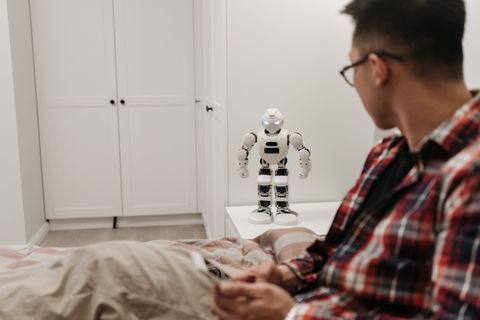
Smart Home Robots Guide: Features, Benefits, and Essential Tips
Smart home robots are automated devices designed to perform household tasks, interact with connected equipment, or help people manage everyday activities. They combine hardware, sensors, software, and, in some cases, artificial intelligence (AI) to perform tasks with limited manual intervention.
A robot vacuum cleaner is a familiar example. It navigates floors, detects obstacles, and collects dust according to its programmed settings. Other household robots may monitor selected areas, assist with lawn maintenance, or interact with connected smart home devices.
Smart home technology extends beyond robots. Home automation systems connect devices such as lights, thermostats, cameras, door locks, and appliances so that users can control them through applications, voice commands, schedules, or automated routines.
For example, a homeowner might configure lights to turn on at a particular time, receive an alert when a door sensor detects activity, or schedule a robot vacuum to clean an empty room.
The purpose of this technology is to make household activities easier to manage while providing greater control over connected devices. However, capabilities vary considerably between products, and not every smart device includes advanced AI or autonomous navigation.
Common Types of Smart Home Robots
Robot vacuum cleaners: Automatically clean floors using navigation systems, brushes, and suction mechanisms.
Robot mops: Clean hard floors using water, mop pads, or specialized cleaning mechanisms.
Lawn-mowing robots: Maintain suitable outdoor lawns according to programmed schedules and navigation capabilities.
Companion robots: Provide interactive features, reminders, communication, or entertainment.
Home-monitoring robots: Move through designated areas and use cameras or sensors to observe their surroundings.
Assistive robots: Support selected household activities, depending on their design and intended purpose.
These categories serve different needs. A robot designed for floor cleaning cannot automatically perform the same functions as a mobile monitoring robot or an AI home assistant.
Why Smart Home Automation Matters Today
Smart home automation has become an important part of modern residential technology because it connects everyday devices and allows people to manage household activities more conveniently.
It can help people with busy schedules, households with pets, individuals who need accessible controls, and residents who want greater visibility into selected home activities.
The benefits depend on the quality of the equipment, the layout of the home, internet connectivity, and the user's ability to configure the system appropriately.
Main Benefits of Smart Home Robots
1. Reduced repetitive household work
A robot vacuum cleaner can handle routine floor cleaning according to a schedule. This may reduce the need for frequent manual cleaning, although stairs, corners, cables, and heavily cluttered areas may still require attention.
2. Convenient device management
Smart home devices can be controlled through compatible applications, voice assistants, or automation routines. Users may manage several connected lights or sensors from a single interface when their devices support the same platform.
3. Flexible scheduling
Many robotic cleaning devices allow users to select cleaning times, rooms, or operating modes. Scheduling can help households organize cleaning around their daily routines.
4. Improved awareness of selected home activities
Compatible cameras, motion sensors, door sensors, and monitoring robots can provide notifications about specific events. These features may help users understand what is happening in their homes, but they do not guarantee complete security.
5. Accessibility and independent living
Voice commands, automated lighting, and certain assistive robots may help people who find some household tasks difficult. The usefulness of these technologies depends on the person's needs, the device's capabilities, and the reliability of its controls.
6. Better coordination between devices
When compatible equipment works together, one event can trigger another action. For example, a motion sensor might activate a light, or a home automation routine might pause a robot vacuum when a door is opened.
Smart home technology can provide practical advantages, but it also introduces considerations involving privacy, maintenance, compatibility, and dependence on electronic systems.
Essential Features of Smart Home Robots
Understanding a robot's features helps beginners determine whether it suits their household environment. Product descriptions can use similar terminology for functions that perform differently in practice, so it is useful to understand the underlying technology.
Navigation and Obstacle Detection
Robot vacuum cleaners use different methods to understand their surroundings. Some rely on basic sensors and movement patterns, while others use cameras, laser-based navigation, or combinations of sensors.
More advanced navigation systems can create maps of rooms and plan cleaning routes. Obstacle detection may help a robot recognize furniture, walls, and other objects, although performance depends on sensor quality and environmental conditions.
Before selecting a robot, consider whether it can navigate narrow passages, avoid common household obstacles, and return to its charging dock reliably.
Artificial Intelligence and Smart Home Integration
Smart home AI can help devices interpret information, recognize certain objects, identify patterns, or respond to user instructions. The actual capabilities depend on the software, sensors, processing hardware, and available integrations.
An AI home assistant may understand natural-language commands, answer questions, set reminders, or control compatible equipment. Some systems rely on cloud processing, while others perform selected functions locally.
Smart home integration allows different devices to operate within a shared environment. Compatibility is important because a device may support one application or ecosystem but not another.
Voice Control and Mobile Applications
Voice control allows users to issue spoken commands to compatible devices. Mobile applications can provide additional functions, including schedules, maps, notifications, and operating settings.
These controls may simplify routine tasks, but users should check which commands work without an internet connection and whether particular features require an account or cloud connectivity.
Automatic Charging and Maintenance Alerts
Many robot vacuum cleaners return to a charging dock when their battery becomes low. Some models can also empty collected dust into a larger container or perform selected mop-maintenance functions.
Automatic features can reduce manual involvement, but they do not eliminate maintenance. Brushes, filters, sensors, dust containers, wheels, and mop components still require appropriate care.
Comparing Important Smart Home Features
| Feature | Main purpose | Important consideration |
|---|---|---|
| Smart navigation | Plan routes and map rooms | Mapping accuracy varies |
| Obstacle detection | Identify objects in the robot's path | Small objects may remain difficult to detect |
| Voice control | Operate compatible devices through speech | Supported commands differ |
| Scheduling | Automate tasks at selected times | Incorrect settings can interrupt routines |
| Mobile application | Monitor and configure devices | Privacy and account security matter |
| Automatic charging | Return to a dock when required | Dock placement affects performance |
| Smart home integration | Coordinate compatible devices | Platform compatibility must be checked |
Robot Vacuum Cleaner Guide: Choosing Suitable Features
A robot vacuum cleaner is often a practical starting point for people exploring household robotics. However, the best robot vacuum for one home may not be appropriate for another.
Flooring, room dimensions, pets, furniture placement, cleaning preferences, and maintenance requirements all influence suitability.
Factors to Consider Before Selecting a Robot Vacuum
Floor type: Hard floors, rugs, and thick carpets create different cleaning requirements. Check the manufacturer's stated floor compatibility.
Navigation system: Mapping-based navigation can be helpful in larger or more complex homes. Simpler navigation may be sufficient for smaller, open rooms.
Suction and brush design: Cleaning performance depends on the entire cleaning system, including airflow, brush construction, floor type, and debris characteristics. A single advertised specification does not establish overall performance.
Battery capacity: Larger homes may require longer operating periods or automatic recharge-and-resume functions.
Pet hair management: Households with pets may benefit from brush designs that reduce hair tangling and filters suited to the intended use.
Noise levels: Noise can matter in apartments, shared living spaces, or households where people work from home.
Maintenance requirements: Consider how frequently filters, brushes, mop pads, and dust containers need attention.
Application features: Room mapping, no-go zones, cleaning schedules, and room-specific controls can improve convenience when implemented reliably.
Robot Vacuum Cleaner Types
| Type | Main characteristics | Suitable considerations |
|---|---|---|
| Basic robot vacuum | Automated floor cleaning with simpler navigation | Small, open floor areas |
| Mapping robot vacuum | Creates a map and plans routes | Multi-room homes |
| Vacuum-and-mop robot | Combines vacuuming with floor mopping | Homes with compatible hard floors |
| Self-emptying robot vacuum | Transfers collected dust into a larger dock container | Households seeking less frequent dust disposal |
| Advanced obstacle-avoidance robot | Uses additional sensors or vision systems | Homes with more floor-level obstacles |
No category is automatically the best choice for every household. Compare actual capabilities, maintenance requirements, and compatibility with the home rather than relying exclusively on model names or promotional descriptions.
Smart Home Security Systems and Privacy
Smart home security systems can combine cameras, door sensors, motion detectors, connected locks, alarms, and mobile notifications. Some systems also integrate with home-monitoring robots or voice assistants.
These technologies can help users monitor selected areas and respond to particular events. However, connected security devices introduce privacy and cybersecurity considerations because they may collect video, audio, location-related information, or device activity data.
Practical Smart Home Security Tips
Change default passwords and use strong, unique credentials.
Enable multi-factor authentication when available.
Install firmware and application updates promptly.
Review camera permissions and microphone settings.
Disable unnecessary remote access and features.
Use separate network access for smart devices when practical and supported by the router.
Check how long video recordings and other personal data are retained.
Review which household members or external accounts can access device information.
A camera-equipped robot may record areas that household members or visitors consider private. Users should understand where recordings are stored, who can access them, and whether information is processed locally or through remote servers.
Smart home security systems are best treated as one component of household safety rather than a replacement for physical precautions, appropriate locks, or emergency procedures.
Recent Developments in Smart Home Robotics
Smart home technology continued to evolve during 2026, with developments involving AI-enabled home ecosystems, household robots, device interoperability, and more detailed robotic cleaning controls.
June 2026: AI-Enabled Home Ecosystems
On 10 June 2026, LG Electronics described its evolving AI Home approach, combining connected appliances, AI coordination, and autonomous home robots within a broader smart home environment. The announcement illustrated an industry direction toward coordinating multiple household devices rather than treating each device as an isolated product. These capabilities remain dependent on the supported equipment and software ecosystem.
March 2026: More Detailed Robot Vacuum Controls
The Home Assistant 2026.3 release, announced on 4 March 2026, introduced a clean-area action for supported robot vacuums. The feature allows users to request cleaning for mapped areas through the home automation platform, subject to device and integration compatibility. This illustrates how smart home software can provide more precise control over compatible robotic equipment.
September 2026: AI Companion Robot Developments
At IFA 2026, Tuya Smart announced Doova, an AI home companion robot intended to support independently living older adults. The company described features involving environmental monitoring, voice interaction, movement, and coordination with connected household devices. These are company-announced capabilities, not proof that every function will perform reliably in all home environments.
Emerging Areas to Watch
AI assistants that understand more natural-language instructions.
Robots that coordinate with lights, sensors, and connected appliances.
More detailed room mapping and cleaning controls.
Greater attention to privacy settings and local data processing.
Continued development of common communication standards for connected devices.
These developments suggest that smart home systems are moving toward closer integration. Nevertheless, users should verify availability, compatibility, and supported functions before assuming a particular feature will work with their equipment.
Smart Home Laws and Policies in India
Smart home robots are affected by several areas of Indian law, particularly personal data protection, cybersecurity, electronic equipment standards, and consumer protection.
The rules that apply depend on the device, the information it collects, the organization processing that information, and the circumstances in which the equipment is used.
Digital Personal Data Protection Act, 2023
India's Digital Personal Data Protection Act, 2023, establishes a framework for processing digital personal data. The Digital Personal Data Protection Rules, 2025, were notified on 14 November 2025, with implementation scheduled in phases.
These rules are relevant to the processing of personal information by connected devices and the organizations operating their associated platforms. Applicability and specific obligations depend on the law's provisions, implementation timeline, and circumstances.
For smart home users, practical privacy precautions include reviewing device permissions, understanding data collection practices, and checking how recordings and account information are managed.
Information Technology Act, 2000
The Information Technology Act, 2000, provides a legal framework for electronic records and addresses specified cyber-related offences. It remains relevant to India's digital environment alongside applicable rules and other legislation.
Users should secure connected devices and accounts against unauthorized access and follow appropriate procedures when reporting suspected cyber incidents.
Consumer Protection Act, 2019
The Consumer Protection Act, 2019, provides a framework addressing consumer rights and unfair trade practices. Information describing a smart home robot should accurately represent its functions and limitations.
For example, claims about navigation, obstacle detection, camera capabilities, or compatibility should be assessed against the device's documented specifications rather than assumed from general AI terminology.
Electrical and Wireless Equipment Requirements
Smart home devices may also be subject to applicable electrical safety, wireless equipment, and conformity requirements in India. Requirements depend on the product category and its technical characteristics.
Before installing a connected device, check that it is intended for the relevant electrical supply, follows the manufacturer's installation guidance, and meets applicable requirements.
Frequently Asked Questions
1. What are smart home robots?
Smart home robots are automated devices that perform selected household tasks, such as vacuuming floors, mowing lawns, or monitoring designated areas. Some can also interact with connected home equipment.
2. What is the difference between a smart home robot and a smart home system?
A smart home robot performs specific physical or interactive tasks. A smart home system connects and coordinates compatible devices such as lights, sensors, cameras, appliances, and robotic equipment.
3. What should beginners consider when choosing a robot vacuum cleaner?
Consider floor types, navigation, battery capacity, brush design, pet hair management, noise, maintenance, and application features. The most suitable combination depends on the home's layout and cleaning requirements.
4. Are AI home assistants and smart home devices secure?
Security depends on device design, software updates, account protection, network configuration, and data-handling practices. Strong passwords, multi-factor authentication, careful permission management, and regular updates can help reduce risks.
5. Can smart home robots operate without an internet connection?
Some robots can perform basic functions locally, while other features require internet access, cloud processing, or a connected application. Check the manufacturer's documentation to understand which functions remain available offline.
Conclusion
Smart home robots combine automation, sensors, software, and sometimes artificial intelligence to support household activities. Robot vacuum cleaners, companion robots, and home-monitoring devices represent different approaches to making selected tasks easier to manage.
Understanding navigation, maintenance, privacy, security, and device compatibility helps beginners assess these technologies realistically. A well-planned home automation system should reflect the household's actual requirements rather than relying on advanced features alone.
As smart home AI and connected robotics continue to develop, users should pay attention to practical capabilities, data protection, applicable Indian regulations, and long-term maintenance. With informed decisions and responsible configuration, smart home technology can become a useful part of everyday household management.

Related Post...
Technology Guide: Types, Basics, Benefits, and Essential Tips for Beginners
Updated: October 22, 2026
Read More
Renewable Energy Technologies: A Complete Guide to Clean Energy Solutions
Updated: October 27, 2026
Read More