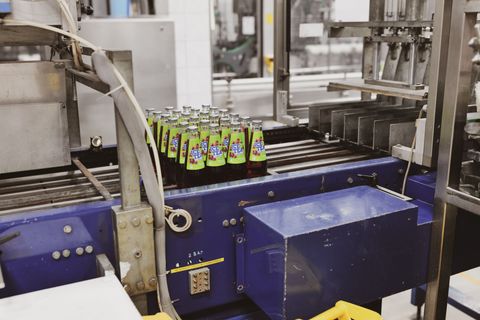
Milk Bottling Plants Guide: Explore Types, Processes, Equipment, and Essential Tips
Milk bottling plants are specialized industrial facilities designed to process, prepare, and package milk for distribution and consumption. They form an important part of the dairy industry by connecting milk collection, processing, quality control, packaging, storage, and transportation.
Modern dairy facilities use a combination of mechanical equipment, food-processing technology, refrigeration systems, and automated controls. These systems help maintain product consistency, manage production activities, and support hygienic handling throughout the processing environment.
A milk bottling plant may operate as part of a larger dairy processing facility or as a dedicated packaging unit receiving processed milk from another production location. Its size and configuration depend on production capacity, milk varieties, packaging formats, regulatory requirements, and operational objectives.
What Is a Milk Bottling Plant?
A milk bottling plant is an organized production system that prepares milk for packaging in bottles, cartons, pouches, or other approved containers. Although the word bottling traditionally refers to bottles, modern milk packaging facilities often handle multiple packaging formats.
The basic objective is to transfer processed milk into suitable containers while maintaining hygienic conditions, accurate filling, appropriate sealing, and product traceability.
Common activities include:
Receiving milk from collection centers or processing units.
Conducting preliminary quality checks.
Processing milk through appropriate treatment systems.
Cooling and maintaining controlled temperatures.
Filling containers with the specified quantity.
Sealing or closing packages.
Inspecting packaged products.
Storing finished products under suitable conditions.
Milk bottling technology combines food engineering, fluid handling, packaging machinery, sanitation procedures, and quality assurance.
Why Milk Bottling Plants Are Important
Milk is a perishable food that requires careful handling and temperature management. Proper processing and packaging help protect product quality and reduce contamination risks.
Milk bottling plants support several important functions:
Hygienic handling: Equipment designed for food processing helps reduce contamination risks.
Consistent packaging: Automated filling systems can support repeatable filling operations.
Product protection: Suitable packaging helps protect milk during storage and transportation.
Production management: Integrated machinery helps organize processing and packaging activities.
Traceability: Batch records and production information help identify products and processing stages.
Distribution readiness: Properly packaged and refrigerated products can be prepared for controlled distribution.
These facilities are relevant to dairy cooperatives, milk processing organizations, food manufacturers, agricultural enterprises, and regional dairy operations.
Types of Milk Bottling Plants
Milk bottling plants differ according to production capacity, automation level, packaging format, and the type of milk being processed.
Small-Scale Milk Bottling Plants
Small-scale facilities generally handle comparatively limited production volumes. They may use semi-automatic filling systems, compact pasteurization equipment, storage tanks, and basic packaging arrangements.
These plants are commonly designed around simpler production layouts and may require more manual handling than larger automated facilities.
Typical characteristics include:
Compact processing and packaging equipment.
Limited production capacity.
Semi-automatic filling operations.
Smaller storage and refrigeration systems.
Flexible production schedules.
Simplified control systems.
Small-scale installations still require appropriate sanitation, temperature control, food safety procedures, and quality monitoring.
Medium-Scale Dairy Bottling Plants
Medium-scale facilities combine processing equipment with more integrated packaging systems. Depending on their configuration, they may include automated milk transfer, pasteurization, filling, sealing, and product inspection.
These plants can support multiple packaging formats and production batches.
Their design generally emphasizes efficient equipment arrangement, manageable maintenance requirements, and coordination between processing and packaging operations.
Large Industrial Milk Bottling Plants
Industrial milk bottling plants are designed for high-volume production environments. They commonly incorporate automated processing lines, advanced filling machinery, integrated conveyor systems, and computerized monitoring.
Typical features include:
Automated milk transfer and processing.
High-speed filling and packaging lines.
Integrated cleaning systems.
Automated temperature monitoring.
Production data collection.
Batch identification and traceability.
Refrigerated product handling systems.
Industrial facilities require careful engineering because equipment performance, product flow, hygiene, and packaging operations must remain coordinated.
Comparison of Milk Bottling Plant Types
| Plant type | Automation | Typical characteristics |
|---|---|---|
| Small-scale | Manual or semi-automatic | Compact layout and flexible operations |
| Medium-scale | Partial to extensive automation | Integrated processing and packaging |
| Industrial | Extensive automation | High-volume production and advanced monitoring |
| Specialized | Depends on application | Designed for particular products or packaging formats |
Plant categories are descriptive rather than fixed capacity classifications. Actual production capacity depends on the equipment configuration, operating conditions, and product requirements.
Milk Bottling Plant Equipment and Its Functions
Milk bottling plant equipment includes machinery used for milk preparation, processing, transfer, packaging, storage, and sanitation. Each component contributes to a particular stage of the production process.
Milk Reception and Storage Equipment
Milk reception systems receive raw milk from collection tanks or transportation vehicles. They commonly include pumps, pipelines, weighing or measuring arrangements, sampling equipment, and storage tanks.
Storage tanks are designed to hold milk under controlled conditions before processing. Their construction, insulation, agitation arrangements, and cleaning features depend on the application.
Milk Processing Plant Equipment
Milk processing plant equipment prepares milk for packaging through operations such as filtration, separation, homogenization, pasteurization, and cooling.
Important equipment includes:
Milk filters: Remove certain physical impurities from incoming milk.
Cream separators: Separate cream from milk using centrifugal principles.
Homogenizers: Reduce fat globule size to support a more uniform distribution.
Pasteurizers: Apply controlled heat treatment to reduce harmful microorganisms.
Plate heat exchangers: Transfer heat efficiently between fluid streams.
Cooling systems: Reduce and maintain milk temperature after processing.
Processing tanks: Support controlled holding, mixing, or preparation activities.
The equipment selection depends on the milk product, processing method, production capacity, and applicable food safety requirements.
Automatic Milk Bottling Machine
<AsyncImageGroup query={["automatic milk bottle filling and capping machine dairy production line","industrial milk bottle conveyor filling machine stainless steel"]} aspectRatio="16:9"/>
An automatic milk bottling machine performs filling and, depending on its configuration, may also include container handling, sealing, capping, and inspection functions.
Automated machines use sensors, control systems, and mechanical components to coordinate packaging operations.
Common features include:
Automatic container positioning.
Controlled filling mechanisms.
Filling-volume adjustment.
Bottle detection sensors.
Integrated capping or sealing arrangements.
Conveyor synchronization.
Production monitoring interfaces.
Automatic filling technology can support repeatable packaging operations, but filling accuracy depends on calibration, product characteristics, maintenance, and operating conditions.
Industrial Milk Bottling Machine
Industrial milk bottling machines are designed for production environments with larger packaging volumes and continuous or extended operating schedules.
Depending on the design, they may use volumetric, flow-based, gravimetric, or other filling principles.
An industrial machine may be integrated with:
Bottle rinsing or preparation equipment.
Filling stations.
Cap feeding and closure systems.
Conveyor belts.
Labeling machinery.
Inspection systems.
Packaging and palletizing equipment.
The overall line configuration determines how these functions are coordinated.
Dairy Processing Plant Equipment Overview
| Equipment | Primary function |
|---|---|
| Milk reception tank | Receives and temporarily holds incoming milk |
| Separator | Separates cream from milk |
| Homogenizer | Reduces fat globule size |
| Pasteurizer | Applies controlled heat treatment |
| Cooling system | Maintains suitable product temperatures |
| Filling machine | Transfers milk into containers |
| Capping machine | Applies container closures |
| Labeling machine | Applies product identification labels |
| CIP system | Cleans compatible equipment internally |
| Refrigeration system | Supports temperature-controlled storage |
Milk Bottling Process: Step-by-Step Explanation
The milk bottling process follows a sequence of activities designed to prepare milk, maintain hygiene, and package the finished product appropriately. The exact process varies according to the product type, processing technology, and packaging requirements.
Milk Reception and Quality Testing
Raw milk arrives at the facility in insulated transportation tanks or other suitable containers. Before processing, samples are collected for quality evaluation.
Common preliminary checks include:
Temperature measurement.
Sensory examination.
Fat and solids analysis.
Acidity assessment.
Appropriate microbiological testing.
Screening for relevant contaminants or adulterants.
The acceptance criteria depend on applicable standards and the dairy's quality assurance procedures.
Filtration and Milk Preparation
Accepted milk may undergo filtration or clarification to remove certain physical impurities. Depending on the processing system, it may also pass through a cream separator to adjust fat content.
Milk standardization involves adjusting its fat and other specified components to achieve the intended product composition.
Pasteurization and Homogenization
Pasteurization is a controlled heat treatment used to reduce pathogenic microorganisms and improve milk safety. It does not make ordinary pasteurized milk sterile.
A common high-temperature, short-time pasteurization process uses approximately 72°C for at least 15 seconds, followed by rapid cooling. Other validated time-temperature combinations may also be used.
Homogenization is a mechanical process that reduces milk fat globules into smaller particles. It helps prevent cream separation and produces a more uniform appearance.
Cooling and Temporary Storage
After pasteurization, milk is cooled rapidly to the required temperature and transferred into suitable storage tanks.
Maintaining appropriate temperatures is important because milk remains a perishable food even after pasteurization. Temperature monitoring, tank hygiene, and controlled holding times help support product quality.
Filling, Sealing, and Packaging
Processed milk enters the filling system through hygienic pipelines. Containers are positioned at filling stations, where the machine dispenses the specified quantity.
The packaging process may include:
Container preparation.
Bottle positioning.
Milk filling.
Cap application or sealing.
Labeling and batch identification.
Inspection of packaged containers.
Secondary packaging for transportation.
Packaging materials must be suitable for food contact and compatible with the intended storage conditions.
Refrigerated Storage and Distribution
Packaged pasteurized milk is placed in suitable refrigerated storage before distribution. Temperature control remains important during transportation and retail handling.
Products should be handled according to their validated storage requirements and applicable food safety guidance.
Milk Bottling Plant Installation: Essential Planning Considerations
Milk bottling plant installation involves more than positioning machinery. It requires coordinated planning for production flow, utilities, hygiene, safety, equipment integration, and maintenance.
Plant Layout and Production Flow
A well-organized layout helps reduce unnecessary movement and supports separation between raw milk handling and finished-product operations.
Important layout considerations include:
Raw milk reception and unloading areas.
Processing and pasteurization zones.
Packaging and filling areas.
Refrigerated storage.
Laboratory and quality control facilities.
Cleaning and sanitation arrangements.
Equipment maintenance access.
Personnel movement and hygiene controls.
The layout should minimize cross-contamination risks and allow convenient cleaning of floors, drains, equipment surfaces, and surrounding areas.
Utilities and Infrastructure
Milk processing and bottling equipment requires reliable utilities.
Common infrastructure requirements include:
Electrical power.
Potable water.
Steam or suitable heating systems.
Refrigeration and cooling arrangements.
Compressed air where required.
Drainage and wastewater management.
Ventilation and environmental controls.
Utility capacity should be evaluated according to the machinery specifications and expected operating conditions.
Equipment Integration and Testing
During installation, individual machines must be connected and coordinated with other components of the production line.
Commissioning activities may include:
Equipment alignment and installation checks.
Pipeline connection verification.
Electrical and control system testing.
Sensor calibration.
Filling accuracy checks.
Temperature verification.
Cleaning system validation.
Operator training.
Documentation and maintenance planning.
Testing should be completed before routine production begins. Equipment operation should follow manufacturer documentation and applicable food safety requirements.
Recent Milk Bottling Technology Trends in 2025–2026
Dairy processing continues to incorporate automation, digital monitoring, improved packaging systems, and resource-efficient operations. These developments reflect ongoing efforts to improve production management and food safety.
Automation and Smart Monitoring
Automated dairy systems increasingly integrate sensors, programmable controllers, and digital monitoring interfaces.
These systems can monitor production parameters such as temperature, filling operations, equipment status, and cleaning cycles.
Automation may help operators identify deviations and maintain consistent operating procedures. However, automated monitoring does not replace laboratory testing, maintenance, or trained personnel.
Digital Traceability
Traceability systems record information about milk batches, processing stages, packaging dates, and distribution activities.
Digital records can support product identification, quality investigations, and recall management. Their usefulness depends on accurate data collection, system integration, and appropriate record retention.
Sustainable Dairy Packaging
Packaging discussions during 2025 and 2026 have continued to emphasize material efficiency, recyclability, and reduced environmental impact.
Relevant developments include:
Lightweight packaging designs.
Improved material utilization.
Recyclable packaging formats where infrastructure permits.
Better packaging waste management.
Evaluation of reusable container systems.
Packaging designs that support product protection.
Environmental performance depends on packaging materials, manufacturing processes, transportation, recycling infrastructure, and actual consumer disposal practices.
Hygienic Equipment Design
Modern dairy equipment increasingly emphasizes hygienic design principles, including smooth product-contact surfaces, accessible cleaning arrangements, and reduced contamination opportunities.
Cleaning-in-place systems are widely used in dairy processing to clean compatible pipelines, tanks, and equipment without extensive dismantling.
Effective sanitation still requires appropriate cleaning chemicals, validated procedures, suitable temperatures, and verification of cleaning performance.
Milk Bottling Plant Regulations and Food Safety Policies in India
Milk bottling plants in India are governed by food safety, hygiene, packaging, labeling, and quality requirements. These regulations help establish consistent standards for dairy processing and packaged milk.
Food Safety and Standards Authority of India
The Food Safety and Standards Authority of India (FSSAI) regulates food safety under the Food Safety and Standards Act, 2006.
Dairy processing facilities must comply with applicable licensing, registration, hygiene, and food safety requirements.
Important regulatory areas include:
Food business licensing and registration.
Hygiene and sanitation practices.
Milk composition and quality standards.
Microbiological safety requirements.
Packaging and labeling regulations.
Food traceability and recordkeeping.
Product handling and storage requirements.
The FSSAI's milk and milk products standards specify requirements for different milk categories, including composition and product identity.
Food Safety and Hygiene Requirements
Dairy facilities should establish procedures for cleaning, sanitation, equipment maintenance, personnel hygiene, and temperature monitoring.
Important practices include:
Using potable water for appropriate food-processing activities.
Maintaining hygienic product-contact surfaces.
Preventing contamination during processing and packaging.
Monitoring pasteurization conditions.
Maintaining suitable refrigeration.
Conducting relevant quality testing.
Keeping production and sanitation records.
These practices help support food safety throughout processing and packaging.
Packaging and Labeling Regulations
Packaged milk must comply with applicable food packaging and labeling requirements.
Labels generally contain information such as product identity, net quantity, manufacturer or responsible food business information, batch identification, date marking, and storage instructions, as applicable.
Accurate labeling is important because consumers rely on packaging information to identify products and understand their storage requirements.
Relevant Indian Government Frameworks
Regulation or authority | Relevance to dairy plants |
|---|---|
FSSAI | Food safety, licensing, hygiene, and product standards |
Food Safety and Standards Act, 2006 | Legal framework for food safety |
FSSAI Packaging Regulations | Food packaging requirements |
FSSAI Labelling and Display Regulations | Product information and labeling |
Legal Metrology framework | Applicable packaged commodity declarations |
BIS standards | Relevant technical standards where applicable |
Dairy operators should consult the current FSSAI regulations and applicable amendments before establishing or modifying a processing facility.
Frequently Asked Questions
1. What is a milk bottling plant?
A milk bottling plant is a facility that prepares processed milk for packaging in bottles, cartons, pouches, or other suitable containers. It includes filling, sealing, inspection, and packaging equipment.
2. What equipment is required for a milk bottling plant?
Typical equipment includes milk storage tanks, filtration systems, pasteurizers, homogenizers, cooling systems, filling machines, capping machines, labeling equipment, refrigeration systems, and cleaning-in-place systems.
The exact configuration depends on production capacity, milk type, packaging format, and processing requirements.
3. What is an automatic milk bottling machine?
An automatic milk bottling machine uses mechanical systems, sensors, and controls to perform filling operations with limited manual intervention. Depending on its configuration, it may also integrate bottle handling, capping, sealing, and inspection functions.
4. Why is pasteurization important in milk processing?
Pasteurization applies controlled heat treatment to reduce harmful microorganisms and improve milk safety. Proper cooling and refrigerated handling remain necessary after pasteurization because it does not make ordinary milk sterile.
5. What should be considered during milk bottling plant installation?
Important considerations include production capacity, plant layout, hygienic equipment design, electrical requirements, refrigeration, water supply, drainage, equipment integration, cleaning systems, operator training, and regulatory compliance.
Conclusion
Milk bottling plants are essential components of the modern dairy industry. They combine milk processing, hygienic handling, packaging machinery, refrigeration, and quality monitoring to prepare milk for distribution.
Understanding milk bottling plant equipment, processing stages, automatic filling systems, and installation requirements helps beginners recognize how dairy production facilities operate.
Automation and digital monitoring continue to influence dairy technology, while food safety, hygiene, and traceability remain fundamental priorities. In India, FSSAI regulations and applicable packaging requirements provide an important framework for dairy processing operations.
A well-designed milk bottling plant depends on suitable equipment, coordinated production flow, reliable utilities, trained operators, and effective quality control. These elements collectively support consistent dairy processing and responsible packaged milk production.
SEO keyword coverage: Milk Bottling Plant Equipment, Milk Processing Plant Equipment, Dairy Processing Plant Equipment, Milk Bottling Plant Manufacturer, Automatic Milk Bottling Machine, Industrial Milk Bottling Machine, Milk Bottling Plant Installation, and Dairy Plant Machinery Supplier are incorporated naturally throughout the article.

Related Post...
Scrap Shears Guide: Types, Features, Benefits, and Essential Tips
Updated: October 28, 2026
Read More
Beverage Cooling Systems Guide: Explore Types, Features, Benefits, and Essential Tips
Updated: October 29, 2026
Read More
Solar Water Heater Guide: Explore Types, Benefits, and Essential Tips
Updated: November 02, 2026
Read More